


Saltcedar
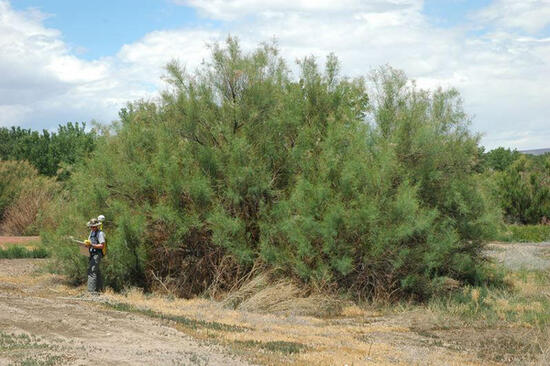
Salt Cedar
Saltcedar - Tamarix spp.
Where does saltcedar come from?
- Saltcedar is a Eurasian native that was introduced into North America in the early 1800s.
- Saltcedar was imported as an ornamental, use for wind breaks, or for erosion control.
- First collected in 1929, Saltcedar can now be found in 49 Kansas counties.
What does saltcedar look like?
- Saltcedar is a small tree or shrub that produces pink flowers May through October.
- The plant?s base is a branched clump with red/brown stems
- Saltcedar can often reach a height of 15-20 feet.
Why is saltcedar a problem?
- Saltcedar forms dense monocultures and dramatically changes vegetation structure and animal species diversity.
- Saltcedar accumulates salt in its tissues, which is later released into the soil, making it unsuitable for many native species.
- Large saltcedar plants can use up to 200 gallons of water a day thus reducing and even eliminating water flow.
- The leaves, twigs and seeds are extremely low in nutrients, and, as a result, very few insects or wildlife will use them.
How do we control saltcedar?
- Saltcedar is difficult to eradicate. It resprouts readily after cutting or burning. Research and many programs are now in place to learn how to reduce or eradicate saltcedar.
- Contact your local Kansas Department of Agriculture office for specific control techniques for an established population.
Images and Recent news
Saltcedar links: